
IAQ IQ, Winter 2025-2026
©2026 Jeffrey C. May
As most of you know, I used to be a home inspector before I left the profession in the early 2000s to focus on being an IAQ professional. I remain a member of both ASHI National and the New England Chapter of ASHI, and I continue to enjoy attending chapter meetings and sharing stories with home inspectors, whom I still consider to be colleagues.
The longer I worked as a home inspector, the more thorough I became. At some point, real estate agents became frustrated with my propensity to find problems in buildings and began to refer to me as “Jeff Dismay.” By that point, I no longer accepted real-estate agent referrals and relied entirely on past-client referrals.
The knowledge and understanding of buildings and building systems that I acquired as a home inspector are critical foundations for my IAQ work. One of the things I loved best about being a home inspector was that I learned something new on nearly every inspection I did. I feel the same way about my IAQ investigations.
I started sending out these newsletters to home inspectors in 2006. In the last twenty years, I have written in detail about many sources of IAQ problems, including both biological (such as microorganisms like bacteria and mold, as well as odors caused by pest infestations) and non-biological (such as VOCs from finishes, furnishings and SPF, as well as possible gas leaks and combustion spillage). In this newsletter, I’m taking a more general approach by summarizing some of the common potential sources of IAQ problems.
If any of you would like to have copies of prior newsletters in which I’ve discussed some of these topics in greater detail, email me (jeff@mayindoorair.com).
Mechanical Systems
- Heavy dust build-up and/or mold growth in ductwork and/or in an air handler is a common problem, especially when a system has been run during construction or renovation work.
- Allergenic dust may be present in the fin tubing of baseboard convectors and between the sections of radiators.
- Mini-splits have inadequate filtration and thus commonly have build-up of dust and mold on components. When a mini-split is used only for heat, components can get dusty but not moldy. If a mini-split is used for cooling, though, the unit can get moldy and thus may need to be cleaned biannually (depending on indoor dust conditions and hours of usage). The need to clean mini-splits should be discussed when home inspectors or HVAC professionals recommend such units.
Some homes have as many as seven mini-split heads installed, so annual or biannual cleaning costs can minimize or even eliminate the monetary savings produced by heat pumps. In addition, the buildup of microorganisms can seriously affect the health of home occupants. Luckily, mold does not affect about 85% of people, but still, the units should be kept clean, as people can develop sensitivities over time when exposed to allergens.
If you want to see what comes out of a mini-split during cleaning, check out YouTube for videos on the topic.
Unfinished Basements
- Unless exposed fiberglass insulation was installed in a basement that has been regularly and adequately dehumidified since the day of construction, over 70% of such insulations are infested with mold growth due to the presence of trapped biodegradable dust and excess moisture.
The fiberglass manufacturers claim that mold cannot grow on fiberglass, a mineral, which is true, but the mold grows on the dust that is trapped in the insulation.
In addition, mice frequently infest fiberglass in basements, and there is a correlation between elevated levels of mouse allergens indoors and exacerbated asthma symptoms.
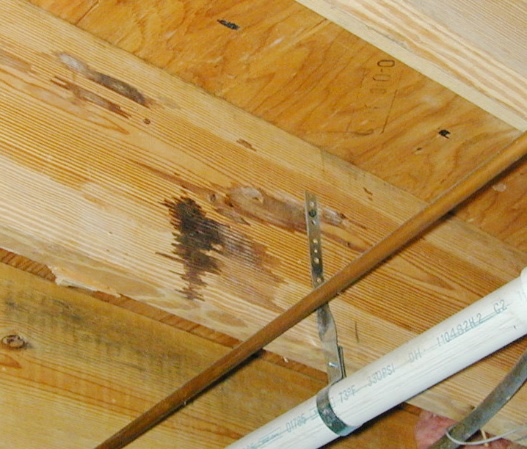
2. Efflorescence on a foundation wall is an indication of excess moisture that can lead to microbial growth (mold, actinomycetes), as well as to infestations of mites that feed on that growth – all of which are potential sources of allergenic bioaerosol.
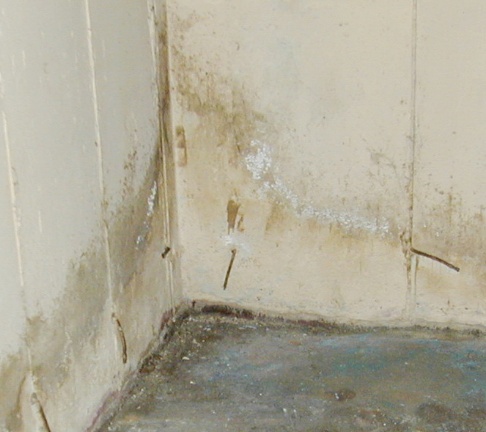
3. When an unfinished basement is full of stored goods, many surfaces that may contain mold growth may not be visible.
Finished Basements
- Carpeting almost always contains mold growth in below-grade spaces, especially at the perimeter, close to foundation walls where conditions can be cool and damp. (Some species of mold can grow when the relative humidity is over 80%, such as in unconditioned below-grade spaces.)
- There could be mold growth and hidden moisture beneath a raised floor.
Many finished basements I’ve inspected ended up in dumpsters!
Inaccessible Crawlspaces
- These can hide all sorts of ills, including mold growth and pest infestations.
Controlling the RH (relative humidity) Below-Grade
The RH in a finished basement with insulated walls must be kept no higher than 60%. This requires air conditioning and/or dehumidification in the humid season (in New England, generally between mid-April and mid-October) and consistent heating in the winter (whether the space is being used or not); the thermostat should be set at no lower than 60oF. The RH in an unfinished basement or crawlspace with exposed masonry walls must be kept no higher than 50%. The RH should be measured separately from a dehumidifier by placing direct-read or remote-read thermo-hygrometers on or near the floor in exterior corners (where conditions can be cooler and damper).
Musty Odors
- A musty odor is a strong indicator of mold growth, whether the odor is above or below grade.
- Musty odors can also be caused by shrews, which are about the same size and the same color as mice but which prey on mice, and which have a skunk-like body musk. These unpleasant animals also often defecate and urinate in piles of damp excrement that develop intolerable musty odors.
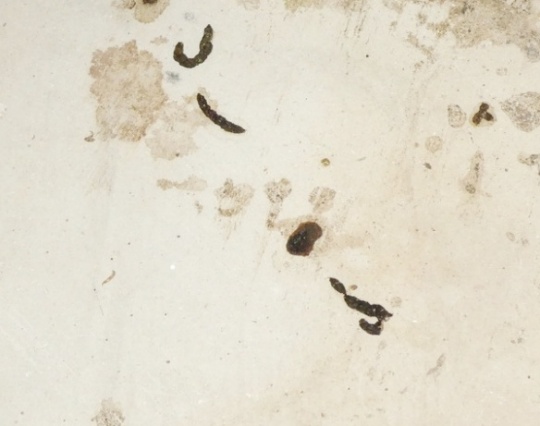
In the last 5 years, we’ve investigated dozens of buildings, including homes, schools and commercial spaces, that had shrew problems. The odor of shrew droppings in fiberglass insulation above a drop ceiling in one school led to abandonment of four classrooms!
SPF Insulation
- Incorrectly processed or installed SPF can emit odorous VOCs for years. Open cell SPF emits an odor than some refer to as “sweet,” and closed cell foam can emit a powerful odor that smells like dead fish.
- SPF dust and airborne SPF droplets contain the ingredients in the foam, including potentially carcinogenic fire retardants.
Case studies: I have investigates homes in which the odor from SPF installations was so strong that the occupants moved out.
Older Homes
- If there are gaps between the floor boards, foot traffic can aerosolize allergenic dust that’s between loose finished-floor boards and the subfloor.
- The soil around an older home may contain lead from lead paint that was removed from the home’s exterior. The soil should be tested before it is used for growing any edible plants and/or before a child plays in the dirt.
Resources
The book How to Operate Your Home, by home inspector Tom Feiza (“Mr. Fix-It”), is a great resource for home occupants and potential homebuyers.
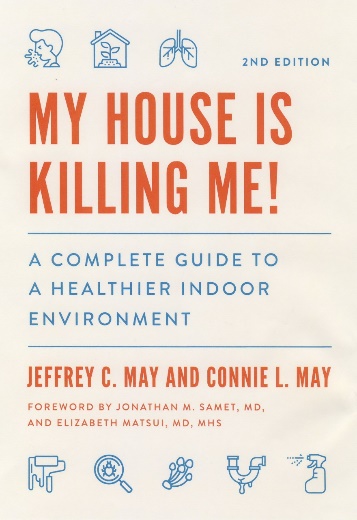
Connie and I have written 5 books on indoor air quality (IAQ), including our latest book, the second edition of My House is Killing Me, which contains new chapters on IAQ problems in multi-unit buildings and questions consumers can ask when considering hiring IAQ investigators or remediation companies. Part III of our book The Mold Survival Guide focuses on mold remediation and removal, including from personal goods.
All three books are available on line
I have referred a number of my clients who are worried about SPF installations in their homes to Henri Fennell, a nationally known expert on problematic SPF installations and who lives in nearby Vermont. https://polyurethanefoamconsulting.com/; 802-222-7740; hfennell09@gmail.com
The photographs in this article are the property of May Indoor Air Investigation but can be used with permission: jeff@mayindoorair.com.
For a fee, I offer a phone consultation to anyone with IAQ or mold questions. I do not charge a fee, however, when buyers who have such questions call me because they were referred by their home inspectors. I’d also be happy to speak to you without a fee if you’ve encountered anything on one of your inspections that may be an IAQ problem: 978-649-1055.