
Homeowner Newsletter, Summer 2026
©2026 Jeffrey C. May
There are some steps to take to reduce allergens and potential allergens in your home. There are also steps that claim to improve indoor air quality but don’t do so, and in some cases such steps can even make things worse.
Let’s start with 4 steps I don’t recommend that people take:
- Don’t use an exhaust-only “dehumidifier” in a basement. Manufacturers claim that such units improve indoor quality. It’s true that the devices exhaust basement air that could contain odors, including musty odors. But these devices don’t get rid of the source of such odors, and they also lower the air pressure in a basement. Since air flows from higher pressure to lower pressure, exterior air could flow back into the basement through cracks/openings in the foundation or in basement windows. That exterior air could contain moisture as well as allergens. If the basement is fairly airtight, then air can flow from the first floor down into the basement, potentially increasing energy costs for heat or air conditioning above-grade (above ground level). I therefore only recommend the use of a condensing type of dehumidifier.
- Don’t use fragrances. Whether delivered by plug-ins, jar candles, or fragranced body, cleaning, or laundry products, fragrances may make interior air (or our bodies) smell more pleasant. Unfortunately, though, fragrances add to the chemical load in indoor air.
- Don’t burn jar candles, even if unscented. Jar candles emit soot particles that not only stain walls and ceilings, but that are also unhealthy to inhale. (One family used jar candles so frequently that they had to repaint the interior of their home three times!)
- Don’t ignore your basement. I’ve been in a lot of spotlessly clean homes with basements that are full of mold growth. People often say to me, “I never go down there,” but since air in a house naturally flows from bottom to top and out, home occupants will inhale the air from a basement even if they never go into the basement. (In an older home, up to 30% of the air in the winter can flow from the basement to above-grade rooms.)
Here are 4 steps I do recommend that people take:
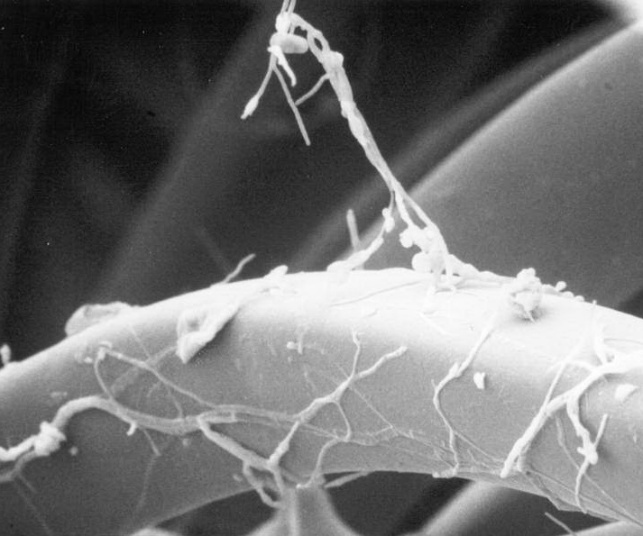
- Use area rugs rather than carpeting, especially if you or anyone else in your household has allergies. And it’s best to avoid carpeting on stairs, which experience a lot of foot traffic. Carpet fibers have more surface area than solid flooring does and can therefore capture more dust. That dust may be allergenic and can never be completely removed, even with the most thorough vacuuming. Some carpet manufacturers claim that carpets “clean” the air by storing dust, but foot traffic can re-aerosolize that dust.
May Indoor Air Investigations
This SEM may be used with permission.
jeff@mayindoorair.com
- Use a vacuum cleaner with a HEPA filter and a bag. Conventional vacuum cleaners exhaust particulates, and emptying a canister vacuum can re-aerosolize dust. If you hire outside cleaners, insist that they use your vacuum and not their own; otherwise, particulate allergens vacuumed up in another house could be exhausted into the air in your home.
- Treat your unfinished basement as if it is part of your home. This will mean controlling the relative humidity by using a condensing dehumidifier during the humid season (in New England, generally between mid-April and mid-October). You should also keep surfaces clean and exercise storage habits that will help avoid mold growth.
- Treat your attached garage as if it is part of your home. This means keeping your garage clean and as in an unfinished basement, storing goods properly. If you dehumidify your garage in the humid season, try to keep the relative humidity (RH) no higher than 70%.
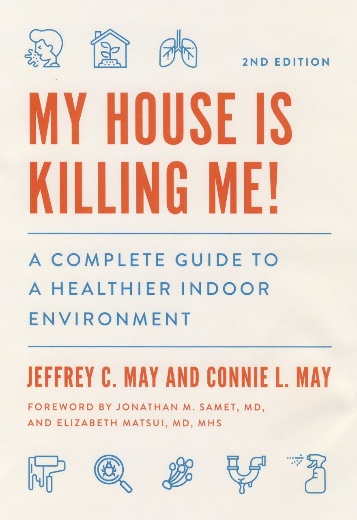
These and many other practical “don’ts” and “do’s” are discussed in detail in our five books on indoor air quality, including the second edition of My House is Killing Me.
A review: “I have purchased many books about creating healthy homes and healthy environments! This book is by far the most comprehensive that I have read. For anyone getting serious about creating a healthy living space for their family or in the inspection field this is a must read!”

Connie’s memoir was recently published.
A review: “A Parade of Drunks is full of rich detail that exposes the heartbreak growing up in an alcoholic family…. I highly recommend this book to anyone who has experienced, or is experiencing, living in a family addicted to alcohol.”
Both books are available on line.